


Japan is one of the most mystical places on the planet. Imagine misty rivers and trees of ever-changing vibrancy and colour compose most of the landscape, all in the shadows of snowy mountains. An echoing silence also dominates most of the shrines outside of the major cities, only broken by the occasional chime or chant. At least, this is what people expect of Japan, though sadly most of the tourism is confined to Kyoto and Tokyo. Getting out of these cities is needed to explore more of the cultural heritage of Japan, and a day trip to Kyoto to Nara is one of the best ways.
Now don’t get me wrong, Nara still suffers from an age-old over tourism issue. However, go past the gates where the tours stay and this place might just surprise you. In fact, you may even get a taste of that mystical Japan which many travellers seek.
Without further ado, here is my quick guide on a day trip to Nara. I’ll include all the key things to know to help you plan ahead, and will point out key things to do in Nara (aside from the deer).
Day Trip from Kyoto to Nara | Your Quick Guide
Getting to Nara from Kyoto
Let’s start off with the big one; how do you get to Nara from Kyoto for your day trip? As this is one of the most popular day trips from the city, services run surprisingly regularly. In fact, you actually have two train lines to choose from.
The best way – in my opinion – is to take the Kinentetsu Limited Express. These trains run regularly between Kyoto and Nara and operate on a private line. The train takes 35 minutes and actually takes you directly to Nara Park, which is highly convenient. Alternatively, you have the JR Nara Line. This is cheaper, but takes 10 minutes longer to get to Nara and it arrives at Nara Station, a good 10 minute bus ride from Nara Park.
Tip: The buses from Nara Station to the park run extremely regularly as a shuttle service. There will be a member of tourism staff on hand to point you in the direction.
Another difference is how you pay for the trains. For the JR Line, just use your Suica to tap on and off. However, for the Kinentetsu line, you need two tickets and so pay two fares; one for the reservation and the base fare. For the latter, you can just pay this on your I/C Card (such as Suica). However, for the reservation you’ll need to purchase a ticket from the ticket office in Kyoto (or a machine).
Overall, I’d recommend the Kinentetsu Line for ease, but to be honest it doesn’t massively matter one way or the other.
Morning
Your first stop has to be Nara Park. It is arguably the main attraction in the city and because of this it gets very busy. And quickly.
To get the most out of your day, I’d aim to get here for about 08:30-09:00am. Of course, you can arrive earlier as the Park is always open, however be aware that the cookie vendors (for the deer) don’t set up until 09:00am.
Entering Nara Park and Deer Cookies
The first part of the Park you’ll likely enter is technically called Noborioji Park. This is where the majority of tourists gather and begin their tours of the city. It is also where you’ll find people selling deer-cookies (shika senbei) for around ¥200. They come in packs of 8 and are served as cute little stacks.
Now let’s get to the main issue. The deers go wild for these cookies. They absolutely love them. You would have heard that the deer in Nara bow to people in exchange for a cookie. Whilst many older deer respect this tradition, there are a fair few mischievous deer who completely disregard it in Nara, and the vast majority of these naughty deer are found – you guessed it – in the tourist hot spots.
My best advice to you is for you to hide these cookies out of sight. If you take a stack of cookies out in Noborioji Park, or by the Nara National Museum, the deer will surround you. Some of them can – and do – nip and nudge you in order to get the cookies… And usually one cookie just isn’t enough!
Top Tip: Hide your cookies until you get deeper into Nara Park. These deer are less familiar with tourists and people and usually behave a little better. I’d also suggest watching deer and how they behave first before deciding who to bow for.


Nara Park Exploration
After you have passed the Nara National Museum, continue up the main path. It will eventually lead you to the Kasugataisha Shrine and goes into a woodland. The further away you get from the National Museum area, the better. I found that there were far fewer tourists and that the deer here seemed much more natural. You could also appreciate the area and the landscape far more than you could near the start of the trail.
What I loved about exploring Nara Park were all of the smaller stonework details against the typical Japanese foliage. I thought that it brought me close to that mystical Japan that I dreamt of. As you ascend up the hill towards Kasugataisha, you’ll notice lots of Tōrō lanterns. These are typically used to symbolise Buddhist cosmology and are found in many sacred spots across Japan, and China for that matter. You’ll also be able to see Jizo statues, who are believed to protect travellers, children and spirits.
If you ignore the tourists and are lucky enough to be here when it is quieter, you’ll find that this is one of the nicer spiritual experiences in your day trip to Nara from Kyoto.


The Second Torii Gate and the Kasugataisha Shrine
At the end of the path is the second torii gate. This is a large structure which is used to symbolise the threshold into a spiritual place. Remember: don’t pass through the centre of the gate; that is reserved for the Shinto Gods.
Continue your walk up to the base of the mountain. You’ll then reach the Kasugataisha Shrine, the most impressive in Nara Park and one of the most sacred in Japan. This area of Nara sits on the foothills of Mount Mikasa, where an ancient Shinto God is supposed to live. In fact, the deer which live here are said to serve this deity as well as others.
The shrine itself is beautiful and dates back to the early 8th Century. I found that the vermillion pillars in the morning light were just what I imagined when I first thought of a Japanese shrine. What was even better is that very few people get up here, let alone pay the entrance fee to go deeper into the shrine. It was a far-cry from the bustling shrines of Tokyo and Kyoto and one which really resonated with me.
Tip: Morning prayers are held at the Kasugataisha Shrine every morning at 09:00. Visitors are welcome to join.


Late Morning: Todai-ji Temple
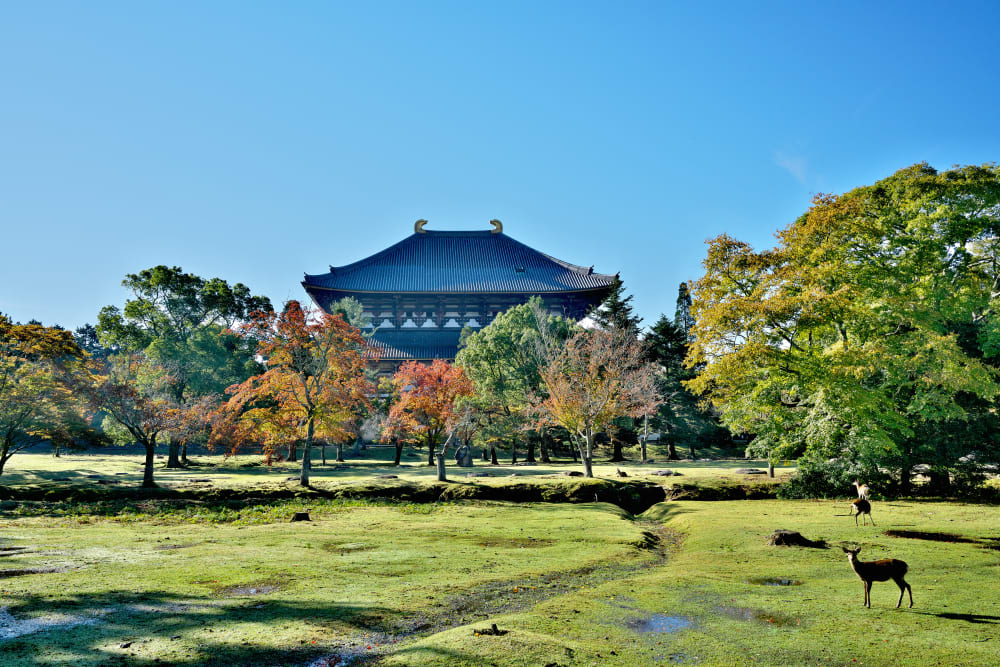
After you’ve explored Nara Park to your heart’s content, head to the Todai-ji Temple. To get here, you’ll need to retrace your steps through the park and then turn right when you reach the National Museum. Continue along this main path and Todai-ji is right in front of you. To be honest, it is so huge that you can’t miss it. You’ll also need to pass through the Nandaimon Gate, which is guarded by two ferocious statues.
Tip: Once again, be prepared for lots of tourists and lots of pushy deer!
This particular temple is incredibly impressive. To start with, Daibutsuden Hall (the main building) held the title for the world’s largest wooden building until very recently held the world record. Inside it though is a current record-holder though so you won’t leave too disappointed. If you go within Daibutsuden Hall you’ll see the world’s largest bronze Buddha statue, which draws in visitors from all over the world.

Lunch
Now that you’ve seen Nara Park and Todai-ji, you’ve actually done the top things to do in Nara. At least, that’s what most travel writers will say. However, did you know that Nara was once the ancient capital of Japan and has a really rich heritage. Arguably, one of the best ways to experience this is with food.
Head on over to Nara-machi, the old town district of Nara. Very few tourists tread here and you’ll be in for a real treat. Some of the specialities here include kakinoha-zushi, a delicious persimmon leaf-wrapped sushi, as well as local mochi and green tea desserts. A must-try though is Nakanishi Yosaburo, a wonderful shop which serves traditional teas and sweets, and has done so for 150 years! No trip to Nara is complete without a stop here.
Tip: Did you also know that Nara take their sake very seriously? In fact, it is renowned all over for how good the produce here is. If you wanted to buy some for a souvenir, this would be the place to do it… Not the airport in duty free!


Afternoon
In the afternoon of your day trip from Kyoto to Nara, you have a few different options. One quite nice thing to do is to head back into the park with a coffee, sit down and just take in the atmosphere. You can also try to get some more photos of the deer!
If that doesn’t quite sound what you are after, then here are some other alternatives:
- Stop at the Kofuku Temple to see the giant five-story pagoda here. These structures have many uses, but my favourite reason has to be that they were lightning rods to prevent fires. There is also a series of historic relics to see.
- The Isuien Gardens are quintessentially Japanese and should be on the list of anyone with an interest in horticulture. The name ‘Isuien’ translates as the “garden founded on water“, a name stemming from the high number of ponds here.
- We walked past it earlier, but the Nara National Museum is one of the top things to do in Nara. It is an art museum which specialises in Japanese Buddhist art. The pieces here are all unique and strikingly beautiful. Perfect for any art-lovers wanting to experience Japan.

Final Thoughts | Day Trip from Kyoto to Nara
A day trip from Kyoto to Nara is a must-do for any traveller. As I said at the beginning, you’ll be hard pushed to unlock the magic in Japan through just seeing Tokyo and Kyoto, and you almost certainly won’t appreciate the mystical nature of this country. Nara however does allow tourists to leave with a glimpse of it. Not too much, mind you, but enough to leave anyone hungry for more.
I hope that you found my post on a day trip to Nara from Kyoto helpful, and that it helped you understand what there is to do in Nara. As always though, please ask if you have any questions. I always love hearing from you.


